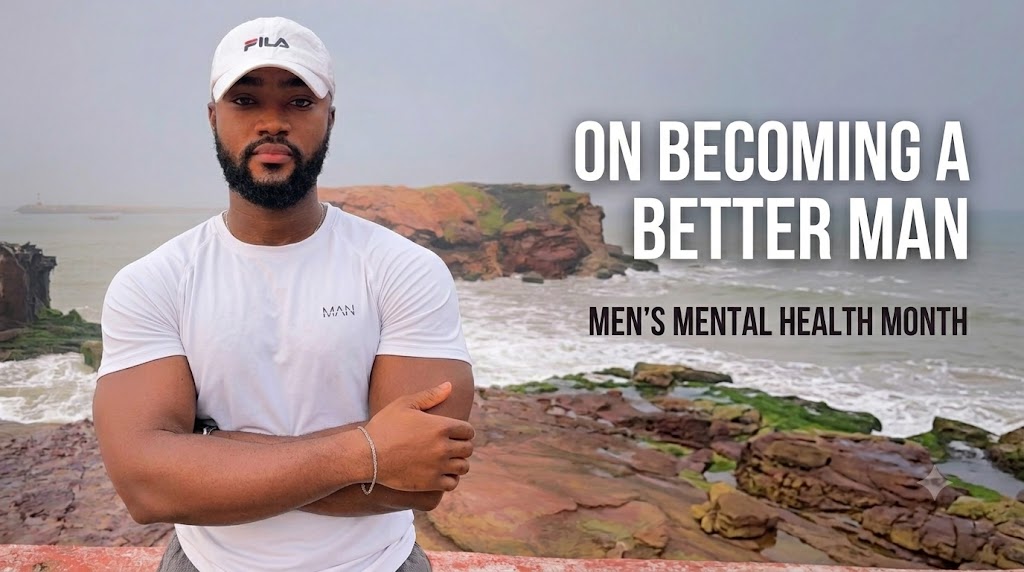
Before my blog took on a more personalized format, when I started seven years ago, my articles were strictly focused on mental health. In fact that was almost all I wrote about. And while most of my posts were relatable to both men and women, I was particularly happy to find out my audience was predominantly male. When I started my blog, my goal was to create a space where conversations around mental health could happen openly, honestly and without judgment. As our community grew bigger, I turned to a more personalised approach where I shared my experiences beyond mental health because I wanted my readers to see not just what I believed, but how I was learning, stumbling, growing, and navigating life myself.
Over the years, I have shared a number of my struggles on this blog and as Men’s Mental Health Month comes around each year, I find myself reflecting on how much has changed. Not just in my circumstances, but in the way I see the world. I have let go of opinions I once held with complete certainty. I have changed my mind more times than I’d like to admit. And somewhere along the way, I became interested in the things we don’t often talk about. The conversations that happen behind closed doors. The emotions we learn to hide. The experiences that quietly shape us but rarely make it into the stories we tell about ourselves.
The more I paid attention to those things, the more I noticed a pattern. Many men spend their lives carrying an invisible set of expectations. The message is rarely spoken aloud, yet somehow most of us hear it all the same: be strong, keep going, don’t complain, don’t let anyone see you struggle. And over time, those ideas become difficult to separate from our identity. We start to believe that being a man means being unaffected by pain, self-sufficient at all times and capable of carrying every burden alone. We learn to treat emotions as problems to solve rather than experiences to understand.
We have been made to believe that being a man means having everything figured out and under control. Staying composed. Keeping our emotions tucked away. Being the person everyone can lean on without ever needing someone to lean on in return. And particularly for me, it hasn’t been a difficult view to adopt. Growing up, I watched my father carry a lot of responsibility with a quiet strength that I admired. In many ways, he is my blueprint for manhood. But as I’ve grown older, I’ve come to appreciate that strength isn’t as one-dimensional as I once thought.
In fact, I think we’ve misunderstood what strength really looks like.
Real strength isn’t pretending that nothing affects you. I think it is being willing to acknowledge what does. It is sitting with disappointment instead of distracting yourself from it. It is confronting your insecurities rather than burying them beneath productivity, achievement or distraction. It is allowing yourself to feel the full weight of an experience without running from it. And at least to me, that seems much harder.
Similarly, I believe one of the greatest displays of strength is honesty. The honesty to admit when you’re struggling. The honesty to acknowledge when you’re hurt. The honesty to experience joy without downplaying it, grief without hiding it and fear without feeling ashamed of it. The easier option is often to look away. To brush things under the carpet because we’re not ready to confront them. To avoid conversations because they’re uncomfortable, inconvenient or difficult.
But emotions are stubborn things. They don’t simply disappear because we ignore them. They wait. They linger. And more often than not, they find a way of making themselves heard. They surface in our relationships. In our tempers. In our loneliness. In the quiet moments when there is no work left to distract us and no audience left to perform for. The real prowess of manhood, then, is not found in denying your humanity. It is found in embracing it.
The men I admire most aren’t the loudest in the room or the toughest on the surface. They’re the ones who know themselves, through and through. The ones who have done the difficult work of understanding who they are beneath the expectations, the labels, and the performance. There is something incredibly powerful about a man who is comfortable being himself. Repeat after me;
There. is. something. incredibly. powerful. about. a. man. who. is. comfortable. being. himself.
Some people see it as softness, but I see it as the fullness of being a man. Confident enough to pursue his goals with conviction, yet self-aware enough to confront his mistakes, learn from them, and begin again.
In the relatively short time I’ve been here, I would define strength as emotional ownership. Yeah, that’s what I believe it is. Sitting with every part of yourself, your past mistakes and acknowledging them without shame. Being willing to feel deeply without allowing those feelings to define you. Because confidence is not the absence of imperfections. It is the acceptance of them, fully.
As a Christian, it would be remiss of me not to reference the Bible in this context. We look at figures of strength and think that to lead means to be hot-headed and bland. But I think observing the life of some of the greatest men in the Bible says otherwise. A perfect example I like to cite is David. David is famously described as “a man after God’s own heart”, yet he was one of the most lethal military commanders in the Bible. I think he provides the ultimate blueprint for the balance between raw, unrelenting aggression in battle and deep, weeping vulnerability before God.
In fact I think it’s safe to say the Bible never presents manhood as a choice between strength and tenderness. Moses also led nations yet the whole time dealing with insecurity. Paul preached boldly while speaking openly about his weaknesses. When describing his ministry in Corinthians, he said: “I came to you in weakness with great fear and trembling.” Nonetheless, he stood before kings and governors. Men we need to understand that courage isn’t the absence of fear. It is acting despite it. Even Jesus Christ wept (John 11:35). Abi you strong pass your Lord and Personal Saviour?
We do not have to choose one over the other, but rather learn to carry both gracefully. We need to be self-aware enough to understand what we feel and have the confidence to express it, to admit when we are afraid, speak when we are overwhelmed, ask for help when we need it, and celebrate our victories without feeling the need to downplay them. We need to reach a point where we stop trying to become the person we think the world wants and start becoming the person we actually are. To me, that is where true masculinity resides. Stand firmly in your truth and remain unapologetically yourself. Because there is no greater display of strength than a man who no longer feels the need to hide.
Before I wrap up, I’d leave you with this; The goal shouldn’t be to become an unshakable man. It should be to become a balanced one. Someone capable of pursuing his ambitions with conviction, but also willing to admit when he’s struggling. Someone dependable enough to support others, yet humble enough to lean on them when necessary. And truthfully, I’m still learning this myself.
For reasons I can’t fully explain, asking for help sometimes feels harder than carrying the burden alone. It doesn’t make much sense, but if you’re reading this, there’s a good chance you understand exactly what I mean. The difference is that I’m trying not to stay there. I am a work in progress. I’m learning that the people who care about me would much rather listen to my problems than deal with the consequences of my silence. That’s a lesson I’m still working through.
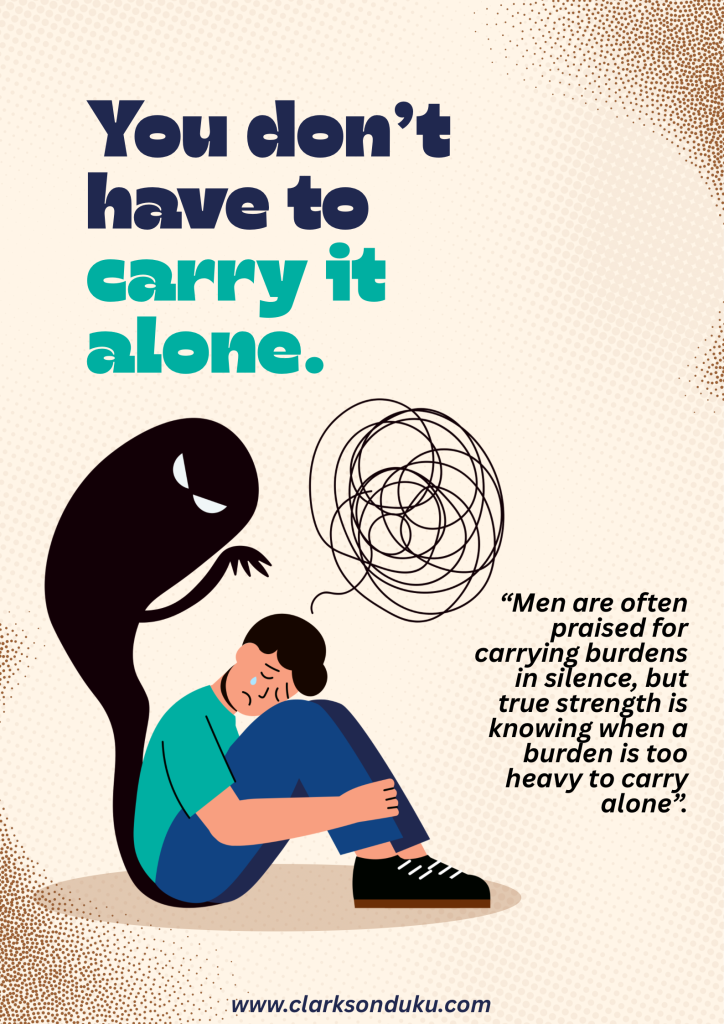
So if you take anything away from this article, let it be this; You don’t have to carry everything by yourself. And on the days when life feels heavier than usual, I hope you remember that. Perhaps you can even come back and read this again. I know I probably will. Happy Men’s Mental Health Month 💙
Incredible read to set my morning. Deeply appreciated!
Thank you. I’m really glad it found you this morning. I appreciate you taking the time to read it.